


Foldable Gift Box with Ribbon: Six Closure Types Compared
2026-11-06
A foldable gift box with a ribbon closure is a box whose ribbon is threaded, stitched or glued into the flat blank before the box is folded, so it still ships flat and the ribbon arrives already positioned. The closure is rarely structural: on most formats the ribbon holds a lid shut, carries the box, or hides the seam where lid meets wall. What makes it a specification decision rather than a decoration is that the ribbon changes the folding sequence, the packing state and the labour content of the order.
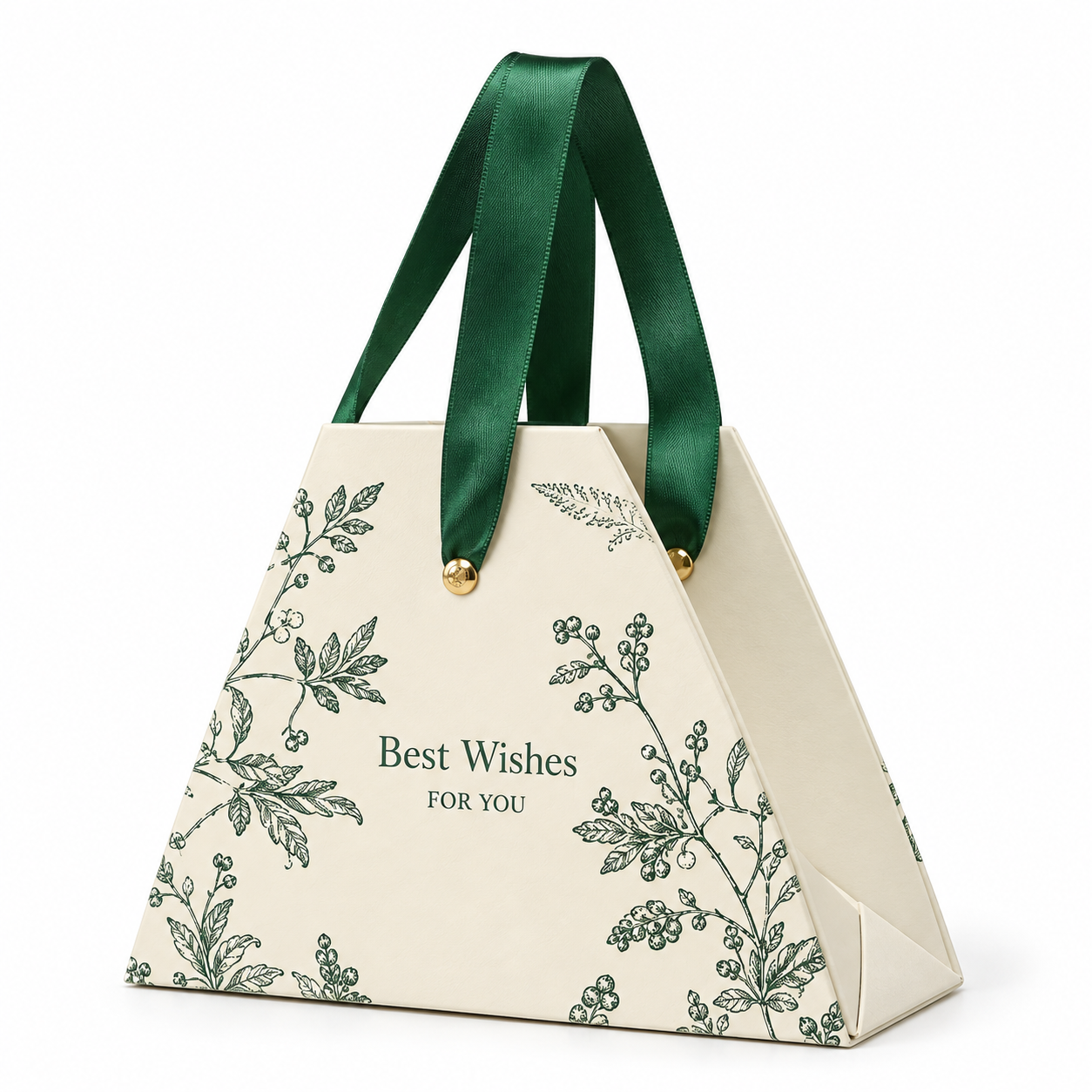
This page covers the six ways a ribbon is attached to a foldable box, which weaves survive handling, the length and slot geometry that decide whether a bow looks right, and how to specify it so a factory quotes what you pictured.
The six ways a ribbon closes a foldable box
Suppliers use the phrase "ribbon closure" for at least six different constructions, and they are not interchangeable. The cost index below is relative to the same box with no ribbon (no ribbon = 100).
| Type | How it works | Ships | Cost index | Where it fails |
|---|---|---|---|---|
| Slot-and-tie | Ribbon threaded through two die-cut slots, buyer ties a bow on opening | Flat, ribbon loose | 104–108 | Slot tears on thin board; tails crease in the pack |
| Pre-tied bow | Bow machine-tied and stitched or glued to the lid; decorative only | Flat, bow flattened | 108–116 | Bow does not recover its shape after compression |
| Wrap-around band | Single ribbon encircles the closed box and is tied at the front | Assembled | 105–110 | Slips on a smooth laminate; pressure marks the wrap |
| Drawstring | Ribbon runs through eyelets or a hemmed channel and cinches the opening | Flat or assembled | 110–120 | Eyelet pull-through; channel too tight to cinch |
| Ribbon hinge | Ribbon bridges lid and base as the only hinge on a two-piece box | Flat | 107–112 | Adhesive creep; misalignment after 20+ cycles |
| Ribbon pull | Short tab under the lid edge to break a friction fit | Flat | 102–105 | Tab too short to grip; pulls out of the seam |
Slot-and-tie is the default for retail gift packaging: the cheapest route to a bow that looks hand-made, and an untied ribbon packs smaller than a tied one. Pre-tied bows cost more and suit the case where a shopper opens the box in a shop and nobody will tie anything.
If the box needs real holding force rather than a decorative knot, that is a different build — read how magnetic closures are engineered into a box wall before comparing prices, because a magnet set and a ribbon tie solve different problems.
Which ribbon weave suits which job
Weave decides three things that matter commercially: whether a knot holds, whether the surface takes print, and how the ribbon behaves after a week in a flat pack.
| Weave | Hand | Knot holding | Print / foil | Notes |
|---|---|---|---|---|
| Grosgrain | Matte, ribbed, firm | Excellent — the rib grips | Screen print and hot foil both work | The safest default; hides creases well |
| Satin (double-face) | Glossy, fluid | Poor — knots work loose | Foil yes, print smears | Needs a double knot or a stitched tack |
| Cotton / linen | Matte, dry, slightly irregular | Good | Print yes, foil poorly | Frays unless hot-knife sealed or folded |
| Organza | Sheer, stiff, springy | Fair — will not lie flat | Rarely printed | Sharp edges; needs a heat-sealed cut |
| Velvet | Deep pile, soft | Good | Not printable | Crushes where the flat pack presses it |
The common mismatch is satin on a box a customer will tie. Satin photographs better and holds a bow worse than grosgrain in the hand. If the tie is part of the ritual, specify grosgrain; if the bow is tied in the factory and never retied, satin is fine.
The folding constraint most buyers miss
The ribbon goes on before the fold. On a collapsible box the ribbon is threaded through slots in the flat blank while the blank is still flat. Once the walls are folded and the base panel locked in, threading a ribbon through an internal slot is no longer practical at volume. A ribbon change late in a project is a tooling change, not a trimming change.
A tied bow does not ship flat. Anything tied is a three-dimensional object, and a flat pack compresses it. Either the box ships with the ribbon threaded and untied, or the bow is pre-tied in a flattened state and relies on the customer fluffing it up. Both are legitimate and they are quoted differently.
The tails have a length limit. Long tails look generous in a photograph and tangle in a carton. Beyond roughly 150 mm, tails start to crease permanently under a 20 kg carton load, and the crease sits exactly where the bow will be tied.
The assembly sequence is worth reading once on a first foldable project — the step-by-step assembly guide shows where the ribbon station sits on the line.

Ribbon length, width and slot geometry
Ribbon is bought by the metre and consumed by the box, so length decides cost. For a single band that crosses the lid once and ties at the front:
Length = 2 × (L + W) + 2 × D + bow allowance, where L and W are the box footprint and D the depth. The bow allowance covers two loops and two tails; on a 20 mm ribbon with 100 mm tails, budget 400 mm. A second crossing band adds 2 × (L + W) again plus a second allowance, which is why cross-tied boxes cost more in ribbon alone.
| Box footprint | Ribbon width | Single-band length | Cross-tied length |
|---|---|---|---|
| 100 × 100 mm | 10–15 mm | ~0.9 m | ~1.4 m |
| 200 × 150 mm | 15–20 mm | ~1.4 m | ~2.4 m |
| 300 × 200 mm | 20–25 mm | ~1.9 m | ~3.4 m |
| 400 × 300 mm | 25–38 mm | ~2.5 m | ~4.6 m |
Slot geometry is where cheap boxes give themselves away. The slot should be the ribbon width plus 1–2 mm, with a radius at each end, set at least 8 mm in from the board edge so the board does not tear out under tension. Cut exactly to width it jams; 5 mm wider and the bow drifts off-centre. On 1.0 mm greyboard a slot longer than about 40 mm acts as a hinge.
What goes wrong in transit and in the hands
Fraying at the cut ends. Woven ribbon unravels from the cut. The fix is a hot-knife cut, which seals a synthetic weave, or a folded-and-stitched end on cotton. Scissor-cut ends are acceptable only on a box opened once.
Adhesive creep. A glue dot holding a pre-tied bow lets go on a coated wrap in warm conditions and the bow rotates. Stitching through the lid board is more reliable and invisible from outside.
Colour transfer. A dark dyed ribbon against a pale uncoated wrap can migrate under container humidity. Ask for a rub test on the actual pairing, not on a swatch card.
Slot tear-out. Thin board plus a tight slot plus a heavy box equals a torn wall at the first lift. Widen the slot, add a reinforcing patch, or move the load to a die-cut handle.
Memory creases. Ribbon stored folded takes a set. A week in a flat pack is usually recoverable; a month under load is not.
Getting the specification onto the purchase order
Ribbon is the item most often left vague on a PO, and vagueness is where a confirmed sample and a delivered run diverge. Six fields close most of the gap: fibre and weave, width, colour reference, cut and end finish, attachment method, and packed state.
"Red grosgrain ribbon" is not a specification. "38 mm polyester grosgrain, Pantone 186 C, hot-knife cut, stitched to lid panel, shipped untied with 120 mm tails" is. Packed state matters as much as colour: the same box quoted tied and untied differs by the labour line, and a factory that assumes tied will price a bow you did not ask for. The frequently asked questions cover the fields that come up on almost every first order.
What ribbon adds to cost, as an index
Ribbon rarely dominates the unit price, but the labour side surprises buyers. Against the same box without ribbon at index 100: a slot-and-tie with a 20 mm grosgrain band lands around 104–108; a cross-tied version around 110–115; a pre-tied stitched bow around 108–116 depending on loop count; a custom-dyed colour at low volume adds 3–6 points because dye lots carry minimums.
Two levers move the number further than haggling over ribbon price. Cross-tied to single-band removes roughly a metre of ribbon and one tying operation. Shipping untied removes the tying labour entirely and shifts it to the customer — fine for e-commerce, not for a counter sale.
Questions buyers ask
Can a ribbon be added to a box we already have tooling for? Usually not without a die change, because the ribbon needs slots or a stitch line the existing die does not cut.
Is tied or untied cheaper to land? Untied. The ribbon ships flatter, the carton is smaller, and the tying operation is not paid for twice.
Does the ribbon affect recyclability? Often yes, and it is a design decision rather than a material one. Most satin and grosgrain ribbon is polyester, so a removable ribbon makes the paper component easier to place in a paper stream — the conditions are set out here.
How Dongguan Minghan Packaging handles ribbon work
Dongguan Minghan Packaging Products Co., Ltd. builds foldable and collapsible gift boxes in Dongguan, with slotting, ribbon threading and bow assembly done in house alongside die cutting and wrap forming. That matters for ribbon because the slot and the ribbon have to be specified together: a die cut to the wrong width cannot be corrected by choosing a different ribbon afterwards.
We work with grosgrain, satin, cotton and paper-twine ribbons from 6 mm to 38 mm, supplied untied, hand-tied or with stitched pre-tied bows. At Dongguan Minghan Packaging Products Co., Ltd. custom-dyed colours are quoted against a dye-lot minimum rather than absorbed silently, and we will say when a stock colour is close enough to skip it.
What we do not do is promise a bow that survives compression it was never designed for. Where the box ships in a flat pack under load, we specify a ribbon and packing state that match, and send a packed sample so you can compress it before the run.
Send the box dimensions and the ribbon you have in mind for a quoted specification, or start from the folding gift box range to see which formats take a ribbon closure.
Related reading
Recomendado para ti
Ponte en contacto con nosotros