


Collapsible Gift Boxes: How They Fold and What They Cost
2026-11-06
A collapsible gift box is a rigid-looking box that ships flat and folds into shape in seconds. The walls are pre-scored, the corners are built as hinges rather than glued seams, and the whole thing collapses to roughly the thickness of its own board. Buyers choose it for one reason above all others: it cuts freight and storage volume by 60–80% without giving up the wrapped-board look of a rigid box.

This page covers what the structure actually is, which board grades survive repeated folding, where the format fails, and how the cost compares with a conventional rigid box. It is written for buyers who have already been quoted both and want to know why the numbers differ.
Collapsible, foldable, folding carton: three different things
The three terms get used interchangeably in supplier catalogues, and that ambiguity causes real quoting errors. They describe different products:
| Term | What it is | Board | Ships |
|---|---|---|---|
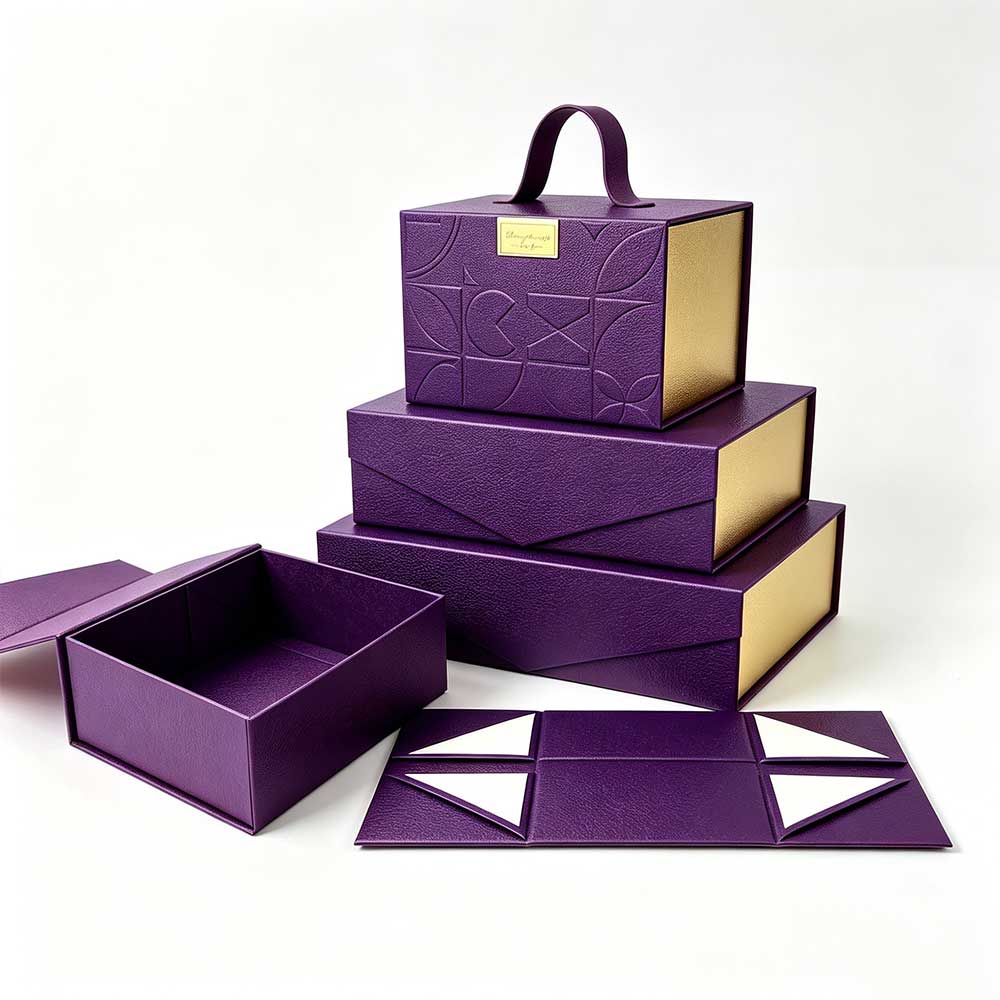
| Collapsible gift box | Wrapped rigid box with hinged corners; folds flat along scored lines and pops up to full depth | Greyboard 1.0–2.0 mm, paper-wrapped | Flat, then assembled by hand |
| Foldable gift box | Same family; in practice the word is used for both collapsible rigid boxes and self-erecting cartons | Varies — ask which | Flat |
| Folding carton | Single-ply printed carton, die-cut and glue-formed from one sheet; no greyboard | 250–400 gsm paperboard | Flat, glued |
The distinction that matters commercially is board. A collapsible gift box has a greyboard core wrapped in printed paper, so it has a thickness and a hand-feel that a folding carton cannot reproduce at any print quality. A folding carton is a printed sheet folded into a box. If your reference sample feels solid at the edges, it is the first one.
How the fold actually works
A collapsible box is not a rigid box with the glue left out. Four things change in the construction:
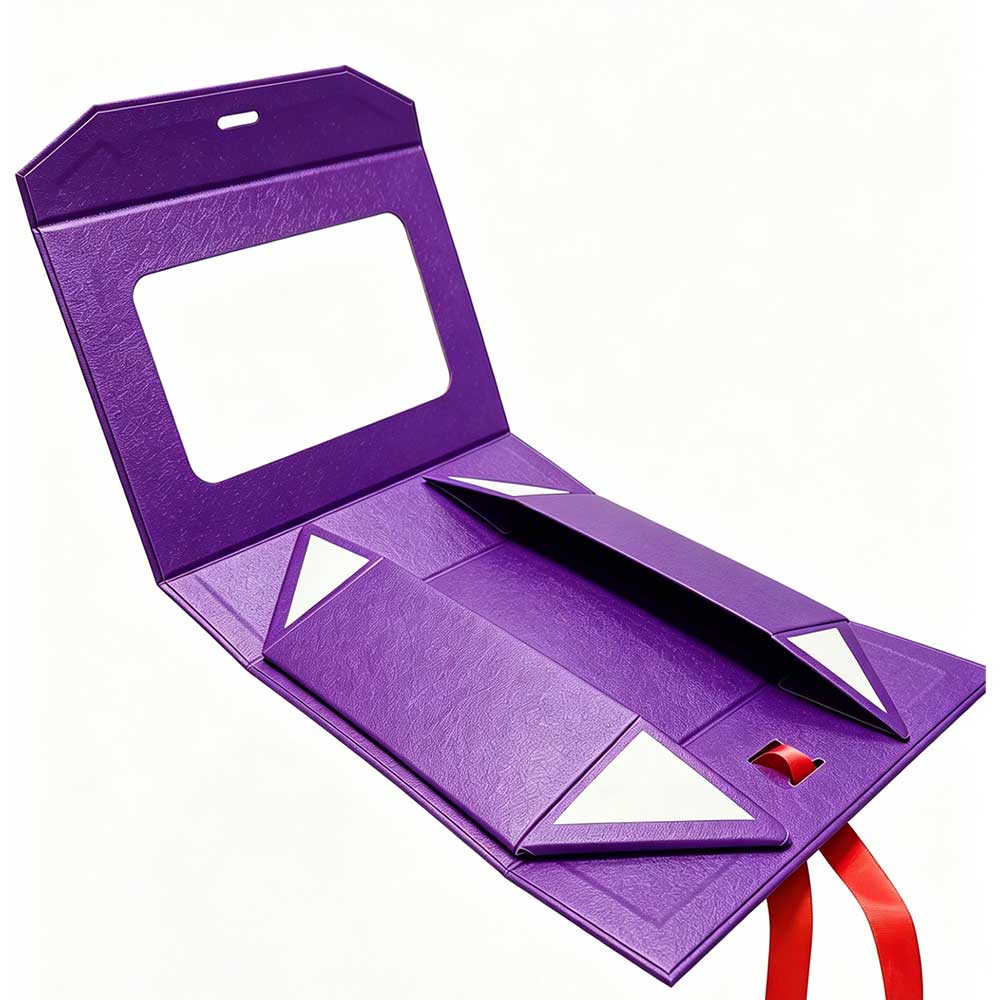
1. Corner hinges instead of glued corners. On a standard rigid box the four vertical corners are wrapped and glued, which locks the walls at 90°. On a collapsible box the wall material is continuous around the corner and scored, so the corner opens and closes like a hinge. The wrap paper bridges the corner on the outside; the greyboard is cut back to leave a gap.
2. Score depth is calibrated, not decorative. Every fold line is pressed to a depth that compresses the board without cracking the printed surface. Too shallow and the box will not sit square; too deep and the wrap splits after a few cycles. This is the single most common quality difference between a cheap collapsible box and a good one, and it is invisible in a photograph.
3. The base is a separate panel. The floor of the box is a board panel that drops into the folded walls and locks them. Because it is not glued, the box can be collapsed again — but it also means the base tolerances have to be tight, or the box will feel loose when lifted loaded.
4. Magnet or ribbon closure is added after folding. Magnetic collapsible boxes carry the magnets in the wall build-up, which stiffens the fold and raises the minimum board weight. Ribbon ties are cheaper and do not affect the fold at all.
Board grades that survive folding
Greyboard thickness is the first specification decision, because it sets both the feel of the box and how many fold cycles it will take. The numbers below are the working range for gift-box construction; the cycle counts are what we specify when a client says the box will be reused.
| Greyboard | Box size it suits | Fold cycles before hinge fatigue | Notes |
|---|---|---|---|
| 1.0 mm | Small favour boxes, under 120 mm | 3–5 | Cheapest; wrap splits first at corners |
| 1.2 mm | Small to medium, 120–200 mm | 5–8 | Common default for retail gift packaging |
| 1.5 mm | Medium, 200–300 mm | 8–12 | Needs a deeper score; better hand-feel |
| 2.0 mm | Large or heavy contents, 300 mm+ | 10–15 | Magnet versions start here |
Two things shorten those cycle counts more than board grade: a coated or laminated wrap, and a very tight fold radius. Soft-touch lamination looks excellent on the first fold and shows white craze marks at the corners by the fifth. If the box is meant to be reused, specify an uncoated or matte-laminated wrap and ask for a folded sample to test yourself rather than a flat printed sheet.
Five collapsible structures and what each is for
| Structure | How it closes | Cost index | Best for |
|---|---|---|---|
| Collapsible lid and base | Separate lid drops over folded walls | 4–6 | General gifting, apparel, hampers |
| Collapsible magnetic | Flap with buried magnets, one-piece wrap | 6–9 | Premium gifts, subscription boxes |
| Collapsible drawer | Folded sleeve plus sliding tray | 6–8 | Jewellery, small electronics |
| Collapsible carry box | Die-cut handle in the lid, no bag needed | 4–7 | Retail takeaway, confectionery |
| Collapsible with window | Lid or wall has a PET or board window | 5–7 | Product-visible retail packaging |
Cost index: a plain tuck-top folding carton at 3,000 units = 1.0. The range reflects size and print coverage, not quality tier.
What collapsible saves you in freight
This is where the format earns its place. A 300 × 200 × 100 mm gift box assembled occupies 6 litres. The same box collapsed occupies about 0.4 litres. The arithmetic on a 20ft container is not marginal:
| Format | Units per carton | Cartons per 20ft | Total units |
|---|---|---|---|
| Assembled rigid box | 25 | 280 | 7,000 |
| Collapsed, same box | 180 | 280 | 50,400 |
For most buyers the practical effect is not a bigger order but a smaller freight bill: the same 10,000 units move in roughly a fifth of the volume, which usually moves the shipment from a full container to a shared one. We worked through the landed-cost maths, including volumetric weight and container fill, in the freight side of flat-packed boxes.
The saving has a counterweight: somebody has to fold them. Budget 20–40 seconds per box for a first-time folder and 8–15 seconds once practised. At 10,000 units that is 22 to 110 labour hours. For a brand packing in-house this is usually fine; for a fulfilment centre charging per unit it can erase most of the freight gain, so check the pick-and-pack rate before committing.
Where collapsible boxes fail
Five failure modes account for nearly every complaint we see on this format:
Corner craze. The wrap splits along the fold after several cycles. Cause is score depth or a laminated wrap, not board thickness.
Loose base. The floor panel does not lock the walls, so the box racks when lifted. Caused by base panel tolerance — usually 1 mm too small.
Magnet misalignment. The lid closes but does not sit flush, because the magnets were positioned from the flat die line and the fold shifts them 1–2 mm. Needs a folded, not flat, approval sample.
Warped lid. A large lid in 1.2 mm board bows across the span. Going up one board grade is cheaper than adding a stiffener.
Print misregistration at the fold. Artwork that runs a printed line exactly on a score will show a hairline crack. Design a 2 mm clear zone either side of every fold.
The spec sheet that gets an accurate quote
Six numbers decide the price of a collapsible box. Send all six and the quote comes back comparable:
Internal dimensions in millimetres (L × W × D, and say whether that is internal or external). Greyboard thickness. Wrap material and finish. Print coverage — full bleed, one colour, or none. Closure type. Order quantity, and whether you need one flat-packed sample or a folded one.
Missing any of these is why two suppliers quote 40% apart on what looks like the same box. There is a longer version of this list in the nine specifications behind a packaging quote.
Cost against a conventional rigid box
At 3,000 units, same size, same print, a collapsible box typically runs 10–20% more per unit than the equivalent assembled rigid box. The premium is for the extra die work and the hand assembly of the hinge build-up. It is repaid at the freight line, not the unit price — which is why the comparison only makes sense on landed cost.
Below roughly 1,000 units the premium widens, because the die and make-ready costs spread over fewer boxes. Above 10,000 units it narrows to single digits. If your volume is under 500, a stock collapsible or a folding carton is usually the better buy; see what MOQ does to unit price.
Questions buyers ask before ordering
Can a collapsible box hold the same weight as a rigid box? Yes, within limits. The base panel carries the load, and a 1.5 mm board base will hold 4–5 kg comfortably in a 250 mm box. Above that, or for anything with a narrow footprint, ask for a double base. Load and stacking behaviour is covered in our stacking tests.
Does it look cheaper than a rigid box? Not when assembled. The difference shows in the corners: a rigid box has a crisp glued edge, a collapsible box has a slightly softer hinge. At arm's length most buyers cannot tell. In the hand, they can.
Can it be printed on all six faces? Yes, but the inside faces need separate artwork consideration — most designs leave them plain or use a contrast liner. Full interior print adds roughly 8–12% because it requires a second pass.
Is it recyclable? The board and paper are; the magnets, ribbon and any PET window are not, in most kerbside systems. A mono-material version without magnets is the recyclable option. We set out the qualification criteria in what actually makes a gift box recyclable.
How Dongguan Minghan Packaging handles this format
We produce collapsible gift boxes in greyboard from 1.0 to 2.0 mm, wrapped in art paper, kraft or textured stock, with magnetic, ribbon, window and drawer variants. Die making and sample folding are done in house, which is what allows us to send a folded sample rather than a flat sheet — the only reliable way to judge a hinge.
If you are weighing collapsible against rigid, send the product dimensions and target quantity. We will come back with both structures priced on the same specification, plus a folded sample of each, so the decision is made on the box in your hand rather than on a catalogue photo.
Send your dimensions for a collapsible box quote — or browse the custom gift box range first.
Related reading
- How to assemble a foldable gift box, step by step
- Are foldable gift boxes strong enough? Load and stacking tests
- Foldable boxes and freight: the maths behind landed cost
- Gift box structure types: 12 styles and what each costs
- Greyboard thickness for rigid boxes: a buyer's technical guide
- Buying foldable gift boxes wholesale: what volume changes
- Collapsible gift box manufacturer: seven capability checks
- Pop-up gift boxes: how they spring open and what to spec
recommended for you
Get in touch with us